Brief Introduction to Plate Tectonics
PLATE TECTONICS
Introduction
If you observe the maps of some of the counrties and continents, they look like landmasses which are broken and seperated. For example, one can clearly observe that the eastern part of Southern America can easily fit into the western border of the African continent. Amazing ! isn't it? Similar observations can however be made.
By looking at such a jigsaw between the continents, German scientist Alfred Wegener in 1912 proposed the "Theory of Continental Drift", which states that all the continents were once joined together into a single landmass which he called as Pangea.During the 1950s and 1960s as the technolgy was improved day by day the theory was experimentally proved. This theory is now globally known as Plate Tectonics.
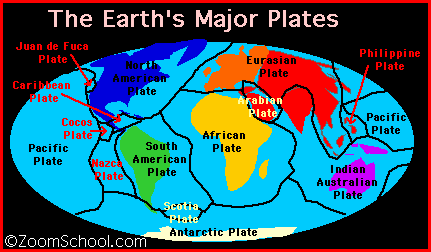
These Tectonics plates are either of Oceanic crust or Continental crust, also forming the upper part of the mantle(The mantle is the largest of crust and core regions and comprises the bulk of the earth’s mass and volume. Temperatures in the mantle are high, reaching about 3700° C (about 6700° F). Pressures inside the mantle are also high, reaching about 137 gigapascals (1.37 million atmospheres)). This part of the earth is referred to as Lithosphere. The region below the lithosphere consists of fluid rock layer called as Asthenosphere. The matter present here move in fluid manner because of high temperature and pressure conditions.
Hence the lithosphere will be able to flow on such a layer which causes the plate movements.
By looking at such a jigsaw between the continents, German scientist Alfred Wegener in 1912 proposed the "Theory of Continental Drift", which states that all the continents were once joined together into a single landmass which he called as Pangea.During the 1950s and 1960s as the technolgy was improved day by day the theory was experimentally proved. This theory is now globally known as Plate Tectonics.
These Tectonics plates are either of Oceanic crust or Continental crust, also forming the upper part of the mantle(The mantle is the largest of crust and core regions and comprises the bulk of the earth’s mass and volume. Temperatures in the mantle are high, reaching about 3700° C (about 6700° F). Pressures inside the mantle are also high, reaching about 137 gigapascals (1.37 million atmospheres)). This part of the earth is referred to as Lithosphere. The region below the lithosphere consists of fluid rock layer called as Asthenosphere. The matter present here move in fluid manner because of high temperature and pressure conditions.
Hence the lithosphere will be able to flow on such a layer which causes the plate movements.
posted by Kiran @ 10:46 PM